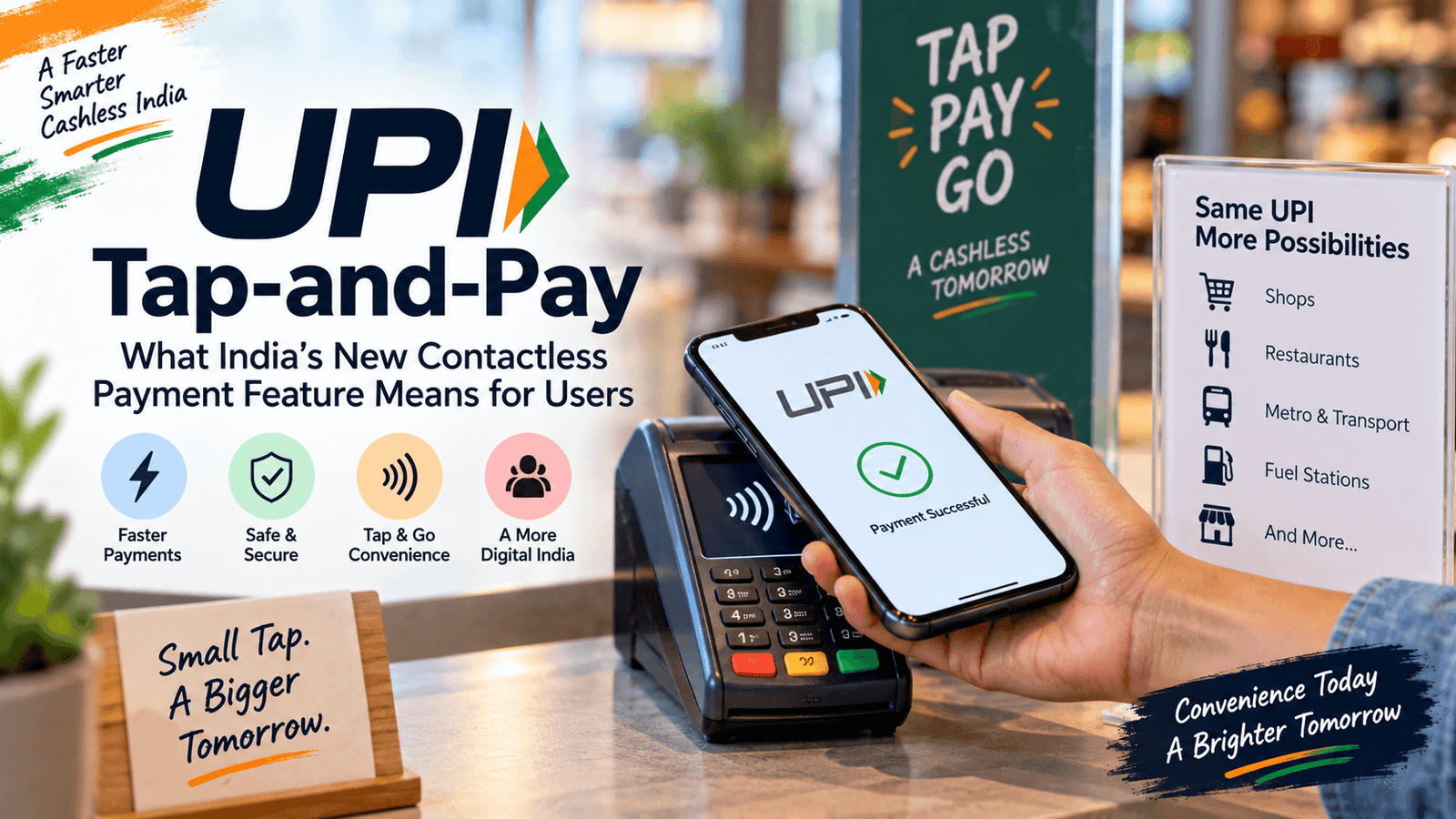
India's digital payment system is getting a new contactless payment option. The National Payments Corporation of India (NPCI) has introduced a new UPI tap-and-pay feature that allows users to make payments by tapping a compatible smartphone on a supported point-of-sale terminal.
The feature uses near-field communication (NFC) technology and is designed to make some everyday payments faster and more convenient.
Here is what UPI tap-and-pay means for users, how it works, and what you should know before using it.
What Is UPI Tap-and-Pay?
UPI tap-and-pay is a contactless payment feature that uses NFC technology.
Instead of opening a UPI application and scanning a QR code, a user with a compatible smartphone can tap the phone against a supported payment terminal to start a transaction.
The new feature adds another payment option to India's already widely used UPI ecosystem.
How Does UPI Tap-and-Pay Work?
The basic process is designed to be simple:
- Use a smartphone that supports NFC.
- Make sure your supported UPI payment feature is enabled.
- Bring your smartphone close to a compatible payment terminal.
- Follow the instructions displayed on your phone or payment terminal.
- Authenticate and confirm the payment when required.
The exact process can vary depending on the bank, UPI application, smartphone and payment terminal.
Why Is UPI Adding Tap-and-Pay?
UPI payments are already commonly made through QR codes across India. Tap-and-pay provides another way to complete a payment without manually scanning a QR code.
This can be particularly convenient at compatible point-of-sale terminals where a quick tap is easier than opening an app and scanning.
According to Reuters, NPCI said the new feature uses NFC technology and is designed to work in areas with little or no network connectivity.
What Is NFC?
NFC stands for Near Field Communication. It is a short-range wireless technology that allows compatible devices to communicate when they are brought close together.
NFC is already used for many contactless payment systems around the world.
NPCI also uses NFC technology for its RuPay contactless payment products.
Learn more about contactless payments from NPCI.
Do You Need an NFC Smartphone?
Yes, NFC support is important for an NFC-based tap-and-pay transaction.
However, having an NFC smartphone alone does not guarantee that the feature will work. The UPI application, bank and payment terminal also need to support the required functionality.
Before relying on tap-and-pay for an important payment, check whether the feature is available in your particular UPI app and on your device.
Is UPI Tap-and-Pay Available Everywhere?
No. Availability depends on the combination of your smartphone, bank, UPI application and payment terminal.
QR-code UPI remains an important payment method and is already widely accepted. Tap-and-pay should be viewed as an additional option rather than a replacement for QR payments.
Will UPI Users Have to Pay a New Charge?
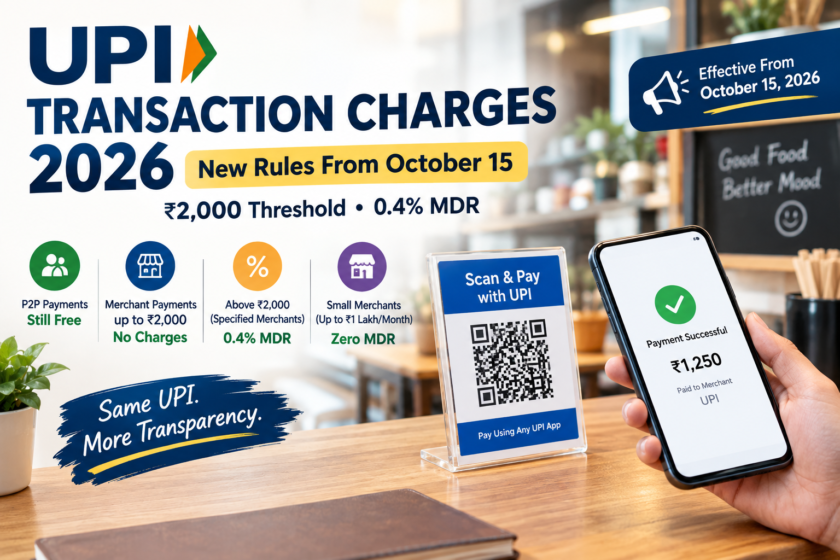
The Government of India has clarified that consumers will not face transaction charges for making UPI payments.
The government has also stated that person-to-person UPI transactions will remain free.
There has been discussion around Merchant Discount Rate (MDR), but that should not be confused with a new charge on ordinary consumers.
The Ministry of Finance said that if MDR is introduced, it would apply only to a limited set of merchant transactions above a specified threshold and would not be a blanket charge on all UPI transactions.
Read the Government of India's official UPI clarification.
UPI Tap-and-Pay vs QR-Code Payments
| Feature | UPI Tap-and-Pay | QR-Code UPI |
|---|---|---|
| Technology | NFC | QR code |
| Payment method | Tap a compatible smartphone on a supported terminal | Scan the merchant's QR code |
| Phone requirement | NFC-compatible smartphone | Camera-enabled smartphone |
| Merchant requirement | Compatible contactless payment terminal | UPI QR code |
| Availability | Depends on supported devices and terminals | Widely available |
What Are the Benefits of Tap-and-Pay?
The new feature could offer several practical benefits.
- Faster payments: A tap can be quicker than manually opening an app and scanning.
- Contactless experience: Users can pay without physically handling a payment card or scanning a printed QR code.
- Convenience: It provides another option for everyday payments.
- Works with NFC: The technology is already familiar from other contactless payment systems.
- More payment choices: Users can continue using QR codes and other UPI methods where appropriate.
Is UPI Tap-and-Pay Safe?
Users should follow the same basic digital-payment safety practices they already use with UPI.
- Keep your smartphone protected with a secure screen lock.
- Never share your UPI PIN with anyone.
- Check the payment amount before confirming a transaction.
- Do not approve an unexpected payment request.
- Keep your banking and UPI applications updated.
- Report suspicious transactions to your bank or payment provider promptly.
NPCI also advises users not to share their UPI PIN. Your UPI PIN is used to authorize bank transactions and should remain private.
Visit NPCI's official UPI information page.
How Popular Is UPI in India?
UPI continues to operate at an enormous scale.
NPCI's official statistics show that UPI processed approximately 24.51 billion transactions in August 2026, with a total transaction value of approximately ₹29.82 lakh crore.
That scale helps explain why new features such as contactless payments can have a significant impact on everyday digital payments in India.
What Does This Mean for Everyday Users?
For most users, there is no need to immediately change the way they make payments.
If your phone, UPI application and a merchant's payment terminal support the new feature, tap-and-pay could provide a faster alternative for suitable transactions.
At other locations, QR-code UPI will continue to be useful.
What Should You Check Before Using It?
Before trying UPI tap-and-pay, check these points:
- Does your smartphone support NFC?
- Does your UPI application support the feature?
- Does your bank support the required functionality?
- Does the merchant have a compatible payment terminal?
- Is your phone's NFC functionality enabled?
- Are you using the latest version of your payment application?
UPI Is Expanding Beyond QR Payments
UPI has developed from a simple bank-to-bank payment system into a large digital payments ecosystem.
Recent developments show that India's payment infrastructure is moving toward more convenient and varied ways of making transactions.
Alongside contactless payments, NPCI is also working on new technologies involving AI-based payments and agentic transactions, showing that the future of digital payments could extend beyond traditional QR-code interactions.
However, new payment technologies also make security, authentication and consumer awareness increasingly important.
Frequently Asked Questions
What is UPI tap-and-pay?
UPI tap-and-pay is a contactless payment feature that uses NFC technology to allow compatible smartphones to interact with supported payment terminals.
Does my phone need NFC?
Yes. An NFC-enabled smartphone is required for NFC-based tap-and-pay functionality. Support from your bank and UPI application is also necessary.
Can I still use QR-code UPI?
Yes. QR-code payments remain an important part of the UPI ecosystem. Tap-and-pay simply provides another payment option where supported.
Will customers have to pay for UPI payments?
The Government of India has stated that consumers will not face transaction charges for making UPI payments. Person-to-person UPI transactions will also remain free.
Does tap-and-pay work without internet?
NPCI said the new NFC-based feature is designed to work in areas with little or no network connectivity. Actual availability can depend on the specific implementation, device, bank, application and payment terminal.
Is UPI tap-and-pay safe?
Users should follow normal UPI security practices, including protecting their phone, keeping their UPI PIN private, checking transaction details and reporting suspicious transactions quickly.
Final Thoughts
UPI tap-and-pay is an important new development in India's digital payment ecosystem. It gives users another way to make contactless payments without relying exclusively on QR-code scanning.
The feature will not replace every existing UPI payment method. Instead, its usefulness will depend on how quickly banks, payment applications, smartphones and merchants support it.
For consumers, the best approach is to treat tap-and-pay as an additional convenience while continuing to use trusted UPI payment methods that are already available.
As India's digital payment ecosystem continues to evolve, features such as NFC payments could make everyday transactions faster and more convenient.
Sources and Further Reading
NPCI – Unified Payments Interface (UPI)
Government of India – No Charges for UPI Users
Reuters – India launches UPI tap-and-pay option
Related Articles
How to Be More Productive: 10 Simple Habits That Actually Work in 2026
How to Make Your Phone Faster: 10 Simple Tips That Work in 2026
How to Declutter Your Digital Life: 12 Simple Steps for 2026
Read more practical guides and everyday ideas on WriteHubDaily
Disclaimer: This article is for general informational purposes only. Payment features, availability and terms may vary between banks, UPI applications, smartphones and merchants. Always verify important payment information through your bank, UPI application, NPCI or official government sources.